Showing posts with label jewelry. Show all posts

Monday, March 7, 2011

Jewelry Making Supplies Wire


You need oodles of patience and practice if you want to use wire to create jewelry designs. The most cost effective and cheap wire that you can use as a beginner is 18 gauge copper wire. This wire is available in plenty at local crafts stores, hardware stores or online stores and you should first master and practice the fundamentals of wiring with this elementary piece before graduating to other varieties of wires.

Before deciding on the kind of wire, you need to make sure about the kind jewelry piece you will be creating, the type of metal, its color, hardness, cut, size of jewelry to be made and carat (10-24). Based on that you need to decide on the shape of the wire.

The diameter of the jewelry to be made will determine the size of the wire. Thinner the wire, higher is the gauge number. By gauge I mean the size of the wire. Gauge is a term used in USA.

You need a thick wire to create jump rings. A thinner wire will be sufficient for an earring wire. Gold wires are the toughest. Silver is much more soft, malleable and ductile. Sterling silver is more hard and durable. Fixed gauge copper wires are the softest and the most ductile of the lot. It is because of their immense malleability that they are recommended for beginners.

The hardness of the wire will depend on whether they are being used to make jump rings or connectors or clasps. You can choose from 3 degrees of hardness based on your needs – full hard, half hard and dead soft. The hardness will depend on whether you are using gold filled wire or a silver variety.

A wire will become harder and harder as you increase the number or frequency of times it is pulled through the tool. Dead soft happens to be the first variety of hardness. As the name suggests it is very malleable and ductile.

Half hard wires are comparatively stronger but they can still be bent into desired shapes with ease and are ideal for necklaces, bracelets and earrings.

Full hard wires are used to eliminate the need for soldering pieces together.

The available shapes of wires are square, half round, round among others.

When you have graduated to a seasoned pro from a beginner, you can move on to more expensive wires like gold wires, white gold or rose gold wires having a carat of 14 or 18 or 22. 24 carat gold will be too soft.

You can also use the nylon coated wires.

Friday, March 4, 2011

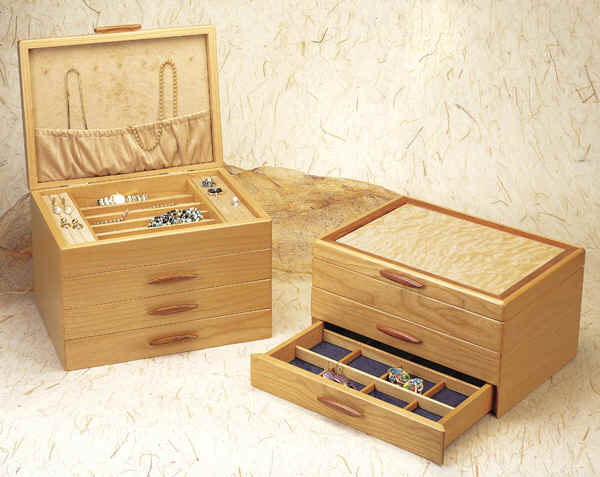
Making a Jewelry Box


People store away their expensive tuxedos and evening gowns with a lot of care, but when it comes to storing their jewelry, most people simply stash away their collection inside drawers, on countertops, in some random box or inside cupboards very carelessly and in a higgledy-piggledy manner after returning from a party and later on cant find accompanying pieces of a particular set.

It is important to store away your collection of jewelry carefully, safely and in one particular place so that you don’t lose them or so that they may not get damaged or stolen. Your jewelry storage needs the same amount of attention and care as your expensive attires.

One of the best places to store your jewelry is a jewelry box. Don’t try to force all your jewelry pieces into one jewelry box. You can store your rings in a jewelry box specifically made for rings and bracelets or necklaces in others designed exclusively for bracelets or neckwear. 

Or you may consider investing in a jewelry organizer which can store all your different jewelry pieces together. This is ideal for those who own few select pieces of jewelry.

Before rushing off to purchase an ornate and intricately carved jewelry casket or trying to create a simple jewelry box on your own, you need to decide what the items that will be going inside it are and what will be their quantity or size. Once you are sure about this you can purchase or make a suitable jewelry box.

The latter is made of different kinds of materials, the chief among them being wood or plastic or metal and is available in various sizes, shapes and for different storage requirements. Jewelry boxes are equipped with inlays, multiple drawers, chests, recesses, secret chambers and pretty designs. They are often fitted with tiny compartments for storing little nick nacks.

Jewelry boxes make for ideal girlie or feminine gifts. Young girls love musical jewelry boxes engraved with cartoon character themes.

Jewelry boxes for adult women are created out of costly wood like walnut, oak, maple, teak, mahogany or ceramic with glass inlays, multiple swing doors, a pretty musical chime clock and intricate patterns in front. These are extremely sturdy, protect your precious jewelry from the elements, look graceful and are showpiece decorative items by themselves.

While selecting or purchasing a jewelry box, don’t just harp on its beauty and elegance, see to it that it is functional and choose a color that will be in contrast with the color of the metal to be stored in it. Don’t choose a silver colored jewelry box for storing white metal jewelry.


Tuesday, February 22, 2011

Metal for Jewelry Making


In this article I shall try to enumerate the most popular picks among metals for creating jewelry.

Gold

Gold is definitely the eternal favorite among jewelry making metals and has won hands down on the popularity charts, down all the ages. All the countries separated by geographical barriers and cultural differences are united on this one common front – fondness for the precious yellow metal that has a very high resale value and emanates a dull yellow shine.

It is also one of the toughest metals, second only to titanium and platinum and can therefore, securely hold precious gemstones in its fold. The carat ranges from 10 to 24. 22 carat gold jewelry is the maximum possible purity that you can expect, but it is rather soft. Most jewelry stores stock 18 to 20 carat gold jewelry which is tough and extremely durable. Gold can be mixed with other alloys to create rose gold and white gold.

White Gold

When normal gold is mixed with palladium or silver and given a rhodium coating to impart a white glow, the alloy is called white gold.

Platinum

A very dense, heavy, super strong/tough and 95% pure
White metal that has warmed its way into people’s heart despite its astronomical cost is platinum. It is one and a half times more expensive than gold, but can securely hold precious gemstones better than any other metal.

Silver

It is much more affordable than gold and therefore more popular. Pure silver is rather soft and ductile and prone to breakage. That is why an alloy called sterling silver has been created out of 92.5% silver and 7.5% copper to impart toughness. Sterling silver does not tarnish with age.

Stainless Steel

Chromium and steel have been mixed to create this anti-corrosive and rust resistant metal that is slowly picking up its way along the popularity charts because of its dirt cheap cost, durability and hardness.

Titanium

A silver white durable lightweight metal that is making waves in the jewelry industry thanks to its hardness (tougher than gold, thrice stronger than steel, toughest metal on earth) is titanium. One cannot solder titanium.

Tungsten Carbide

A highly strong, durable, very heavy, scratch resistant white metal used for making wedding rings for men is tungsten carbide.

Other metals and alloys that are and have been frequently used in the present and in the past for making jewelry are brass, copper, nickel and bronze.


Thursday, February 10, 2011

Making Knotted Jewelry


If precious metal jewelry is out of bounds for you because of their astronomical prices, you need not fret for you can now yourself make or purchase “different” kinds of jewelry from the various online jewelry stores. If you dare to think out of the box and are game for adventurous jewelry, then I will ask you to experiment with knotted jewelry for a change.

Knotted Jewelry

Knotted jewelry belongs to the genre of nautical junk jewelry or costume jewelry and looks best when teamed up with bohemian outfits and gear. Besides they are easy to make or if you want to purchase them, they are easy to find in the numerous online jewelry stores and are very easy on the pocket, being very cheap.

Knotted jewelry consists of necklaces, earrings, bracelets etc. The various attention grabbing designs feature earth toned muted brown ensembles in jute, thread, cords, rustic beads, and natural waxed linen which are all organically woven/knotted into elegant motifs.

The knots that have been used are overhand, double half stitch, square etc.

Material for Knotted Jewelry

Usually knotted jewelry is created out of materials like cords, clasps, jump rings, ivory beads, rust seed beads, natural color waxed linen, matte finish brown wooden beads, glass beads in brown, copper/bronzed patterned wire, brown wool, rust tassels, jute etc.

Knotted jewelry is intricately woven and the rustic flavor of this kind of jewelry helps to enrich the look of Indian ethnic ensembles like saree or salwar kameez. Of course, western gypsy styled bohemian skirts, leather outfits etc can be beautifully accessorized with knotted jewelry of this kind.


Knotted jewelry is wearable artwork that is affordable and makes free use of symbolism in the designs like metaphors of LOVE, LIFE, THE WORD OF GOD, and THE BOOK OF KELLS. It dates back to the Celtic period/ornamental style of the seventh, eighth, ninth and tenth centuries, and the early Middle Ages when this symbolic knotted jewelry design spread out to other far off parts of Europe. Knotted jewelry also has a distinct Chinese heritage.

Celtic Knotted Jewelry

Celtic knotted jewelry patterns were much in vogue during the Elizabethan age and were patronized and used by Michelangelo and Leonardo da Vinci in their works.  Celtic knotted jewelry designs have been a perennial hit with artists and craftsmen in all the ages and in many cultures even previous to seventh century.

Thus when you show off your stunning and head turning nautical knotted jewelry, you are doing your bit to revive and promote a living slice of history - an ancient genre of jewelry making.